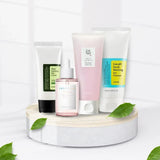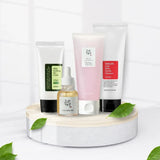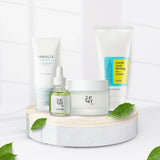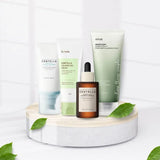


Skin layering is the Korean art of applying several thin layers of skincare to the skin, from the thinnest to the richest. Each layer prepares the skin for the next: the essence hydrates, the serum targets a specific concern, and the cream seals it all in. The idea is not to pile on as many products as possible, but to choose the right ones and apply them in the correct order.
If you're just starting out or are unsure about mixing an essence, serum, and ampoule, this guide will walk you through the method step by step. And if you prefer to start with a pre-built foundation, a complete Korean routine tailored to your skin type will save you from having to guess which product goes with which.
Why layer thin layers instead of using a single cream
In the West, we have long relied on a single cream that is supposed to do it all. The Korean approach is different: several light textures applied one after the other, rather than a single thick layer.
This approach has three practical benefits:
- More comfortable hydration. Water-based textures are easy to apply and do not leave a heavy film.
- A customizable routine. You can add or remove a layer depending on the season, your skin's condition, or your day.
- Targeted skincare. A serum for radiance, a cream for comfort: each product has a clear role.
As Cédric, co-founder, puts it: "More layers do not mean better skin. What matters is the order and consistency."
The order of skin layering, step by step

The golden rule is simple: from the thinnest to the thickest. A fluid texture applied over a rich cream will struggle to spread properly. Here is the classic order.
- Cleansing. In the evening, use a double cleanse: an oil to dissolve makeup and sunscreen, then a gentle cleanser. In the morning, a gentle cleanser or simply water is often enough.
- Toner. It rebalances the skin after cleansing and prepares it for the next steps. Pat it in with your fingertips.
- Essence. This is the basic layer of hydration, which is very fluid. You can learn more in our article Facial essence: what is it really for.
- Serum or ampoule. The targeted step: radiance, uneven complexion, redness, lack of comfort.
- Eye contour. A small amount, patted on without rubbing.
- Moisturizer. It seals in the previous layers and provides comfort.
- Sunscreen, in the morning. Always the last skincare step during the day, before makeup.
Sheet masks and exfoliants are not part of the daily routine: they are added once or twice a week, after the toner.
Essence, serum, ampoule: what's the difference and do you need all three?
This is the question that stops most beginners. All three look similar, but they do not have the same role.
| Skincare | Main role | Place in the routine | Essential? |
|---|---|---|---|
| Essence | Hydrate and prepare the skin | Just after the toner | Useful, especially if your skin feels tight |
| Serum | Target a specific concern daily | After the essence | Yes, if you have a clear goal |
| Ampoule | More intensive skincare, often occasional | After the essence, instead of or before the serum | No, it's a bonus |
| Cream | Seal in hydration and provide comfort | After the fluid skincare products | Yes |
Good news: you do not need all three. An essence and a serum are more than enough for most skin types. If you want to use a serum and ampoule together, apply the thinnest one first, and check that they do not contain two strong active ingredients that accumulate.
How many layers according to your skin type
The right layering depends on your skin, not on a magic number of steps. If you do not know where you stand yet, take our free skin assessment: it will guide you toward the skincare products that truly match your needs.
Combination or oily skin: few layers, all light
Your skin does not like to feel suffocated. Stick to light textures, one serum, and a light cream. The Korean Routine for Combination Skin is built on this principle of light layering, to hydrate the cheeks without weighing down the T-zone. Gwendoline testifies to this in a customer review left on our site: "My skin is perfectly hydrated and has less shine on the T-zone, I recommend this routine by adding +/- radiance or anti-aging products depending on your needs."
If your skin is rather oily, the Korean Routine for Oily Skin aims to cleanse, refine the skin's texture, and control shine, without superfluous layers.
Dry skin: you can layer more
This is the skin type that benefits most from layering. Two layers of essence or toner, then a soothing serum and a richer cream, are often welcome. This is also the principle of the 7 Skin Method. The Korean Routine for Dry Skin is suitable for skin that feels tight and seeks daily comfort.
Sensitive skin: the effective minimum
Every product added is an opportunity for a reaction. Aim for a short and consistent routine: gentle cleansing, a soothing treatment, a cream, and sunscreen. The Korean Routine for Sensitive Skin follows this logic for skin that reacts to the slightest change. N., a customer, summarizes her experience in a customer review left on our site: "It reacts well on my skin, bravo!"
Normal skin or uneven complexion: targeted layering
Normal skin does not need ten steps. The Korean Routine for Normal Skin is ideal if you are just starting out and want a simple foundation. If your goal is a more even complexion, the Korean Routine for Hyperpigmentation helps to reduce the appearance of dark spots and regain radiance. Erica describes it as follows in a customer review left on our site: "Each step is pleasant. The serum absorbs quickly, the cream hydrates without adding shine, and the cleanser is super gentle. [...]"
The mistakes that sabotage good layering
Layering is simple. But a few habits can ruin everything.
- Piling on too many products. Beyond what your skin needs, the layers will pill, the skin will become saturated, and you will no longer know what each product does.
- Not letting it absorb. Wait for each layer to penetrate before applying the next. There is no need to time it: when your skin no longer feels wet to the touch, it is ready.
- Reversing the order. An oil or rich cream before a water-based serum creates a barrier that hinders the next steps.
- Combining strong active ingredients. Retinol and exfoliating acids on the same evening is often too much. Alternate them on different evenings.
- Rubbing instead of patting. The Korean technique is light patting, which respects the skin.
- Forgetting sunscreen in the morning. The best layering in the world loses its appeal without protection.
- Changing everything at once. Introduce one new product at a time to see how your skin reacts.
Morning or evening layering: how to adapt
Your routine does not need to be identical morning and evening.
In the morning, aim for lightness: gentle cleansing, toner, a serum, a light cream, and sunscreen. Your skin should feel comfortable under makeup, not overloaded.
In the evening, it is time to take your time: double cleanse, toner, essence, serum or ampoule, eye contour, richer cream. This is also when you apply your weekly treatments.
For these weekly treatments, the Weekly Routine: Exfoliant + Masks completes your daily layering: the exfoliant after cleansing, the sheet mask after the toner, then you return to your usual routine. It is suitable for combination to normal skin with an uneven texture. Nora describes it in a customer review left on our site: "My skin is smoother, more radiant, and I feel it is healthier. Every week, I take a moment for myself, and it is a real pleasure."
Building your first layering without making mistakes
If you are starting from scratch, begin with four steps: cleanser, targeted treatment, cream, sunscreen in the morning. Observe your skin for a few weeks. Then add an essence if it lacks hydration, or a toner if it feels tight after cleansing.
The routines by skin type are designed for this: skincare products that work together, already in the correct order. All you have to do is follow the steps and adjust according to how you feel. Layering is not a race for quantity, it is a routine that suits you.