

You stick a patch on your spot at night and hope it will have absorbed everything by morning. Sometimes it works, sometimes the patch remains transparent and you wonder if you used it incorrectly. The answer lies in a single mechanism: hydrocolloid. Understanding how it works means understanding why the duration, application time, and type of patch change everything about the result.
In this guide, we detail the exact functioning of spot patches, how long to leave them on depending on the type of blemish, mistakes that sabotage their effectiveness, and why Korean formulas have pushed the technology even further.
Looking for Korean spot patches directly? Our selection includes hydrocolloid and essence formats approved for acne-prone and sensitive skin. (view Korean spot patches)
What exactly is a spot patch? 🔬

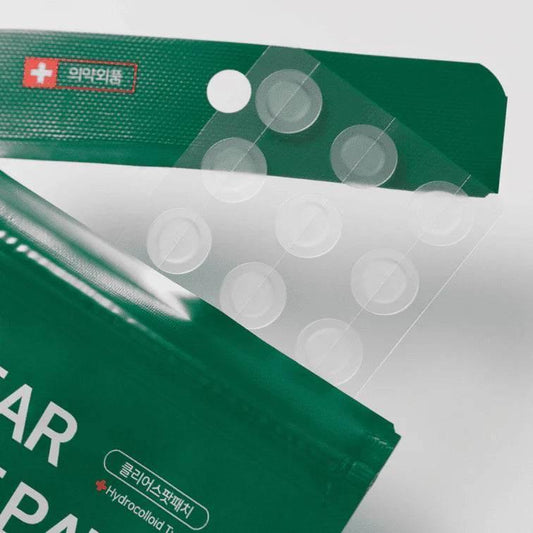
A spot patch is an adhesive disc made of a hydrocolloid gel, the same material used in medicine for dressings on exudative wounds. This gel is composed of absorbent particles, usually sodium carboxymethylcellulose (CMC), dispersed in a gelatin or polyisobutylene matrix.
Upon contact with the moisture from the spot, the CMC particles swell and form a gelatinous matrix. This matrix actively draws sebum, pus, and interstitial fluids out of the pore by osmotic pressure difference. This is why the patch turns white or yellow after use: it has absorbed the contents of the spot.
The other often overlooked role: the patch creates an occlusion. It isolates the spot from outside air, hand bacteria, and friction. This moist microclimate accelerates healing and reduces the risk of secondary inflammation. A study published in the Journal of Wound Care showed that hydrocolloid dressings accelerate skin wound closure by 30 to 50% compared to a dry environment. Source: Journal of Wound Care
Expert tip: Many apply the patch to a barely formed spot, still under the skin. This doesn't work. Hydrocolloid can only absorb what is on the surface or ready to come out. On a deep, unripe spot, the patch has nothing to draw out and often slides off during the night. Wait until the spot is open or has a whitehead, then apply the dry patch to perfectly clean and dry skin.
How long should you leave a spot patch on? ⏱️
This is the question that generates the most confusion. The answer varies depending on the type of blemish and the patch format.
| Type of Blemish | Recommended Duration | Replacement Signal |
|---|---|---|
| Whitehead (pustule) | 6 to 8 hours (overnight) | Opaque, swollen white patch |
| Red, inflamed spot (papule) | 8 to 12 hours | Slightly tinted patch |
| Popped / healing spot | 4 to 6 hours | Patch saturates quickly |
| Deep cystic spot | Not suitable alone | Prioritize anti-inflammatory active beforehand |
The general rule: remove the patch as soon as it is white and swollen, not before. A patch that is still transparent after 4 hours means either the skin was not moist enough when applied, or the spot was not ripe enough. Leaving it on longer will not change anything: a saturated patch loses its absorption power.
Exceeding 24 consecutive hours is counterproductive. Beyond that, the patch begins to macerate the surrounding skin and can cause peri-lesional irritation.
Normal patch vs. essence patch: what's the concrete difference? 💧
K-Beauty has developed two generations of patches with distinct modes of action.
The standard hydrocolloid patch (normal pimple patch) works solely by mechanical absorption. It contains no active ingredients, does not penetrate the dermis, and acts on the surface. This format is preferred for spots with a visible head, pustules, and blemishes in the process of evacuating.
The essence patch or liquid patch incorporates active ingredients dissolved in a thinner, semi-permeable matrix. The most common active ingredients, depending on the formula, include: salicylic acid (BHA) at 0.5-2% to dissolve clogged sebum, tea tree for antibacterial action, centella asiatica to accelerate healing, or niacinamide to reduce residual redness. These patches are suitable for spots still under the skin or early inflammation, as they deliver active ingredients deep down during wear.
A common confusion: using an essence patch on a popped spot. The active ingredients can then irritate an already open surface. Simple rule: closed or forming spot = essence patch, open or ripe spot = classic hydrocolloid patch.
Sensitive skin should check for alcohol and fragrance in essence patches, which can cause reactions on reactive skin.
The 5 mistakes that make your spot patch fail ❌
- Applying to oily skin or with serum on it. Adhesion drops and the patch peels off within a few hours. The patch should be applied as the last step of your evening routine, on clean and perfectly dry skin, with no product between the skin and the patch.
- Applying to an unripe spot. A deep cyst or a completely closed spot gives the hydrocolloid nothing to absorb. Result: transparent patch the next day and frustration.
- Removing the patch too early. A patch removed after 2 hours has not had time to complete absorption. The minimum effective duration for a standard pustule is 6 hours.
- Reusing the same patch. A saturated patch has lost all absorption capacity. Reusing it is like sticking a damp plastic square on your skin, with no benefit.
- Ignoring the diameter. A patch that is too small does not completely cover the spot, leaving the edges exposed to air and bacteria. A patch that is too large macerates the healthy skin around it. The rule: the patch should extend beyond the spot by about 1 to 2 mm on each side.
Can you use a patch under makeup? 💄
Yes, provided you choose the right format. Ultra-thin transparent patches, popularized by K-Beauty, are less than 0.03 mm thick and have a second-skin-like texture. They accept foundation or cushion over them without peeling off or leaving a visible halo.
Thick standard patches, opaque and slightly domed, cannot be worn under makeup: they create a visible bump and foundation does not adhere to them. These formats are reserved for nighttime use.
During the day under makeup, the wearing time is mechanically reduced to a maximum of 4 to 6 hours: facial heat and friction accelerate saturation. Change the patch midday if the blemish is significant.
Korean "micro-dart" or "microneedle" patches work differently: they contain tiny soluble hyaluronic acid needles that dissolve in the upper skin layers to deliver active ingredients deep down. These formats are effective on internal spots but are not compatible with direct makeup application.
Korean spot patch vs. pharmacy: why the difference exists 🇰🇷

Patches sold in French pharmacies (CeraVe, Compeed) are certified medical hydrocolloid dressings, without active ingredients, designed for healing minor wounds. They are thicker, have stronger adhesion, and their formula is less developed for daily cosmetic use.
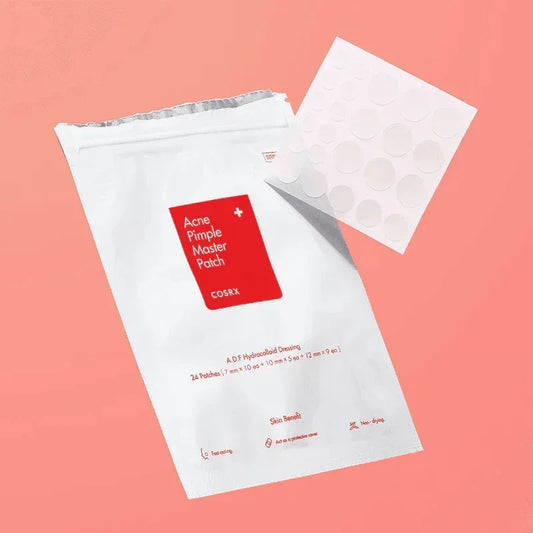
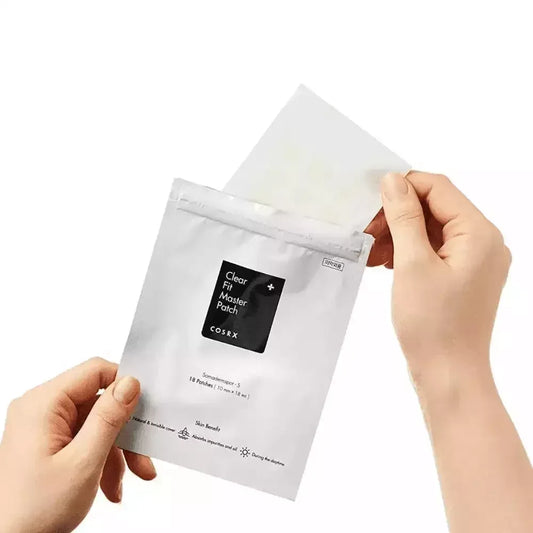
Korean patches were specifically developed for intensive skincare use: ultra-thin formats to go under makeup, packaging with 24 to 76 patches for daily use, and the integration of dermatological active ingredients in essence versions. Brands like COSRX have standardized the format with their Acne Pimple Master Patch, available in 3 sizes to adapt to all types of blemishes.
The price difference reflects the design difference: a pharmacy patch is a medical device, a Korean patch is an optimized daily skincare tool. Both are effective, but for slightly different uses.
If you want to delve deeper into anti-acne care beyond patches, our guide on the Korean acne routine details the active ingredients and steps in order.
What to remember before applying your next patch 📋
The spot patch is one of the few treatments whose effectiveness is directly visible: a white and swollen patch the next morning is proof that the hydrocolloid has done its job. Three points to keep in mind:
- The patch only works on ripe or open spots, not on deep, closed cysts.
- The optimal duration is 6 to 8 hours minimum, never less. Remove as soon as the patch is saturated.
- Choose the format according to the stage: essence patch to prevent and treat deeply, classic hydrocolloid patch to absorb and protect a visible spot.
To discover the selection of Korean spot patches available on Holy Skin, including micro-dart and hydrocolloid formats: view Korean spot patches. And if you want to refine your complete anti-acne routine, the free skin diagnosis gives you recommendations adapted to your skin profile.