Tranexamic acid (TXA) has been the most widely used anti-spot active in South Korea for over ten years, yet one of the least known in France. Unlike vitamin C or hydroquinone, it doesn't irritate, works on sensitive skin, and targets hormonal melasma where other actives fail. If you have spots that have been resistant to your usual routine for months, it's probably what you're missing.
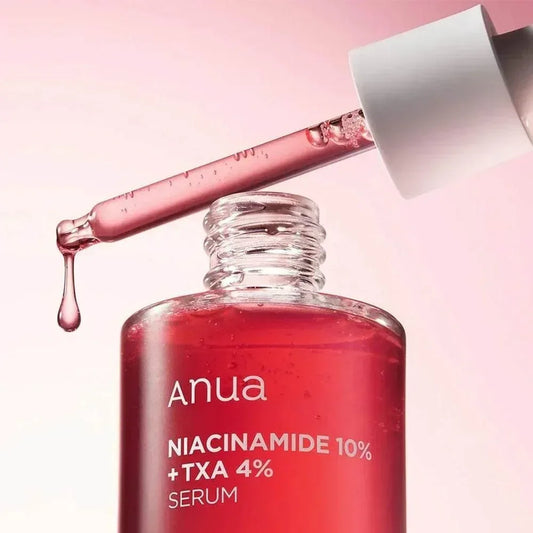
Looking for a TXA serum directly? The Anua Niacinamide 10% + TXA 4% serum combines the two most complementary anti-spot actives on the market, fragrance-free, with visible results in as little as 4 weeks. (view Anua TXA serum)
What exactly is tranexamic acid? 🔬

Tranexamic acid is a synthetic derivative of lysine, an amino acid naturally present in the body. It was first developed in the 1960s as an antifibrinolytic drug to limit bleeding during surgical procedures. It wasn't until the 1990s that Japanese dermatologists observed a marked improvement in melasma in patients treated orally. Topical use in cosmetics followed.
In cosmetics, its mode of action relies on two distinct mechanisms. Firstly, it inhibits the conversion of plasminogen to plasmin, an enzyme involved in inflammatory signals that activate melanocytes. Secondly, it indirectly reduces the expression of tyrosinase, the enzyme responsible for melanin production. The result: less melanin produced, and fewer signals that trigger this production. It's this dual action, both upstream and downstream of the pigmentary process, that distinguishes it from most anti-spot actives.
In cosmetics, effective concentrations range from 2 to 5% in serums, and between 1 and 3% in creams. Below 2%, the effect is essentially preventive. This is why serious Korean formulas display the TXA percentage on the packaging: a useful benchmark for not buying a symbolic formula.
Why does TXA work better than vitamin C on some spots? ⚖️
Not all anti-spot actives target the same stage of the pigmentary process, and that's where the comparison becomes interesting.
| Active | Primary mechanism | Effective on | Limitation |
|---|---|---|---|
| TXA (tranexamic acid) | Blocks plasminogen + reduces tyrosinase | Hormonal melasma, post-inflammatory hyperpigmentation | Progressive action (4-12 weeks) |
| Stabilized Vitamin C | Inhibits tyrosinase + antioxidant | Superficial sun spots, dull complexion | Unstable, can irritate sensitive skin |
| Niacinamide | Blocks melanin transfer to surface | Post-acne marks, overall skin tone evening | Does not act on melanin production |
| Alpha-arbutin | Direct tyrosinase inhibitor | Freckles, sun spots | Less effective on deep melasma |
TXA is particularly superior for hormonal melasma, the most recalcitrant form of hyperpigmentation, often triggered by birth control pills or pregnancy. Vitamin C does not affect the inflammatory signals that cause this type of spot. TXA does. This is why Korean dermatological protocols systematically combine it with niacinamide: TXA blocks production, niacinamide blocks transfer. The two actives act at different stages and reinforce each other without neutralizing.
A study published in the Journal of Drugs in Dermatology (Desai et al., 2019) on a serum combining TXA, kojic acid, and niacinamide showed a measurable improvement in facial dyschromia after 8 weeks in 93% of participants. Source: Journal of Drugs in Dermatology
Who is it really for (and who is it not for)? 👤
TXA is suitable for a large majority of skin types, including sensitive and reactive skin. This is one of its major advantages compared to exfoliating actives or retinoids. It is not photosensitizing at usual cosmetic concentrations, but daily sun protection remains essential during the treatment to avoid reactivating melanin production.
Profiles for whom TXA is particularly suitable:
- Hormonal spots (melasma related to birth control, pregnancy, or menopause)
- Post-inflammatory hyperpigmentation after acne, irritation, or peeling
- Sensitive skin that does not tolerate vitamin C or AHAs
- Medium to dark skin tones, particularly prone to post-acne marks
- Individuals seeking a well-tolerated active for combination with other serums
Cases where TXA alone may not be sufficient:
- Superficial sun spots on fair skin: stabilized vitamin C may be enough
- Deep and old melasma: topical TXA improves but does not replace dermatological follow-up
- Pregnancy and breastfeeding: topical use of TXA is not formally contraindicated, but medical advice is recommended before introducing any active during this period
Expert advice: Many people abandon their anti-spot routine after three weeks, convinced it's not working. TXA requires a minimum of 4 weeks for visible results on light spots, and up to 12 weeks on deep melasma. The delay is not a flaw of the active, it's the incompressible time for cellular renewal. Give your routine time to do its job before changing products.
How to use it in a Korean routine? 🌿
TXA integrates naturally into a Korean routine without altering its structure. It is applied at the serum step, after toner and before moisturizer.
Typical morning and evening routine with TXA:
- Gentle cleanser (oil cleanser in the evening if wearing makeup or SPF)
- Hydrating Korean toner (prepares skin, improves serum absorption by 30-40%)
- TXA serum: 2-3 drops on the entire face, focusing on hyperpigmented areas
- Barrier-repairing moisturizer
- SPF 50+ in the morning (non-negotiable with any anti-spot active)
TXA is compatible with niacinamide, alpha-arbutin, stabilized vitamin C, and centella asiatica. These combinations are common in Korean formulas and are documented as having no antagonistic effects.
To avoid in the same step: exfoliating acids with low pH (concentrated AHAs, BHAs) and high-concentration retinol. Not because TXA is incompatible, but because layering several potentially irritating actives in the same application increases the risk of reaction without additional benefit. The simple rule: if you use a chemical exfoliant in the evening, apply TXA in the morning.
To discover other anti-spot actives to combine, the article on facial dark spots details protocols according to the type of hyperpigmentation.
Side effects and contraindications to be aware of? ⚠️
Topical TXA is one of the best-tolerated anti-spot actives available. Clinical studies report very few adverse effects at cosmetic concentrations (2 to 5%). It does not cause irritation, dryness, or purging unlike retinoids or chemical exfoliants.
Documented side effects remain rare and mainly concern already compromised skin:
- Slight redness upon introduction: start with evening application only for two weeks
- Stinging sensation on reactive skin: sign of a weakened skin barrier, reduce application frequency
- No documented photosensitizing effect at usual topical concentrations
A useful clarification on the term "tranexamic acid danger" which often comes up in searches: almost all serious documented side effects concern oral or intravenous use in a medical context (treatment of hemorrhages), not cosmetic topical application. These are two entirely distinct uses.
Korean TXA serums selected by Holy Skin 🇰🇷

Not all TXA products are created equal. The stated concentration is the first criterion: below 2%, the effect is too limited to be significant. Here are those that combine an effective concentration and a well-tolerated formula.
Anua Niacinamide 10% + TXA 4% Dark Spot Correction Serum: the benchmark for acne-prone skin with residual marks. The 4% TXA concentration is clinically significant. Combined with 10% niacinamide, it targets both melanin production and its transfer to the surface. Light, aqueous texture, fragrance-free, tolerated even on oily and sensitive skin. Visible results on post-acne marks from the 4th week. (view Anua TXA serum)
Medicube TXA Niacinamide Capsule Cream: cream format with active microcapsule technology for targeted active release. Suitable if you are looking for an all-in-one moisturizing and spot correcting treatment at the end of your routine, especially for combination to dry skin prone to pigmentary irregularities.
Mary&May Tranexamic Acid + Glutathione Eye Cream: specifically formulated for the eye contour with 1,000 ppm TXA and 1,000 ppm glutathione. Targets pigmentary dark circles of melanin origin (brownish or dark circles), which do not respond to classic draining or decongestant treatments.
To explore all the skincare products formulated for hyperpigmentation, find our complete selection among Korean anti-spot treatments.
FAQ about TXA 💬
What are the effects of tranexamic acid on the skin?
TXA acts on two levels: it blocks inflammatory signals that activate melanocytes (via plasminogen inhibition) and indirectly reduces the expression of tyrosinase, the enzyme responsible for melanin production. In practice, it diminishes existing spots, prevents post-inflammatory hyperpigmentation after a pimple or irritation, and gradually evens out skin tone. Results are visible from 4 weeks for light spots, up to 12 weeks for deep hormonal melasma.
What are the possible side effects of tranexamic acid on the skin?
At cosmetic concentrations (2 to 5%), TXA is one of the best-tolerated anti-spot actives. Side effects are rare: slight redness upon introduction is possible on very reactive skin, a stinging sensation if the skin barrier is compromised. It is not photosensitizing at these concentrations. Documented serious side effects only concern oral or intravenous medical use, unrelated to cosmetic topical application.
What is the disadvantage of tranexamic acid?
Its main disadvantage is the slow pace of results: it takes at least 4 weeks to observe visible improvement, and up to 12 weeks for deep melasma. It is also not effective on all types of spots: genetic freckles or very old and deep melasma respond little to topical TXA alone and may require dermatological follow-up. Finally, like any anti-pigmentation active, it does not work without daily sun protection.
What is the best acid for hyperpigmentation?
There is no universal answer: it all depends on the type of spots. TXA is most effective on hormonal melasma and post-inflammatory hyperpigmentation. Stabilized vitamin C (10-15%) is better suited for superficial sun spots. Niacinamide is ideal for post-acne marks and sensitive skin. In K-Beauty, the combination of TXA + niacinamide in the same serum, such as the Anua Niacinamide 10% + TXA 4% serum, covers both complementary mechanisms for more comprehensive correction.
Can tranexamic acid be used with other actives?
Yes. TXA is compatible with niacinamide, alpha-arbutin, stabilized vitamin C, and centella asiatica, which are common combinations in Korean formulas. To avoid in the same step: concentrated AHAs or BHAs at low pH and high-concentration retinol, not due to chemical incompatibility, but to limit the potential irritant load. The simple rule: if you use an exfoliant in the evening, use TXA in the morning.
Key takeaways about TXA 📌
Tranexamic acid is the active ingredient to prioritize when spots resist vitamin C or niacinamide alone, particularly hormonal melasma and deep post-inflammatory hyperpigmentation. It acts on two levels of the pigmentary process, is well-tolerated by sensitive skin, and combines seamlessly with niacinamide for a more comprehensive corrective effect.
Two conditions for it to work: a minimum concentration of 2 to 4% in the serum, and daily sun protection without exception. Without SPF, the active works against melanin that UV rays continuously reactivate.
If you're still unsure which active to start with based on your type of spots, our free skin diagnostic provides a personalized routine in 2 minutes.