


If you are looking for reviews of Typology, you have probably already seen polar opposite feedback: customers who love it, and others who report reactions or disappointing customer service. The Trustpilot rating of 3.9/5 from over 2,400 reviews says it all: the brand convinces people, but not everyone, and not always for the same reasons. This guide sorts through it honestly, without the marketing fluff, to help you decide if Typology is right for your skin and your profile.
We are going to cover: what reviews really reveal beyond the stars, why some skin reacts, the brand's real limitations, and what you should check before buying to ensure you don't end up disappointed.
Looking for a targeted active for your specific issue? Korean serums are designed according to need (dark spots, acne, barrier), with protocols that are more documented than Typology's minimalism. (see Korean serums)
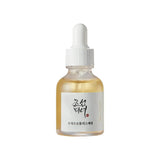
If you are among those looking for a targeted active rather than a minimalist formula, the Glow Deep serum from Beauty of Joseon offers a different philosophy. It combines rice extract and alpha-arbutin to even out the complexion and treat dark spots, with a silky texture that leaves a luminous finish without weighing the skin down. Unlike Typology's minimalism, this serum embraces a richer formula designed for a specific goal. If your priority is radiance and dark spots, you can see the Beauty of Joseon Glow Deep serum as a point of comparison.
What Typology reviews really say beyond the stars 🔎

Reading reviews in bulk always reveals more than the overall rating. With Typology, two main categories of experience clearly stand out, and they do not contradict each other: they reflect different skin profiles.
On the positive side, feedback converges on the quality of the formulas (clean compositions, few controversial ingredients), the speed of delivery, and the readability of the INCI lists. Satisfied users often mention normal to combination skin that is stable and tolerates actives well. The "clean and minimalist" angle also convinces those who pay attention to Yuka scores.
On the negative side, complaints focus on three distinct points: skin reactions (breakouts, redness, dryness), disappointment with customer service (delays, returns, refunds), and shade issues with makeup products (tinted serum, concealer). These themes are not anecdotal: they recur with enough frequency to be taken into account.
The useful takeaway: negative reviews don't necessarily mean "bad brand." They often mean "poor skin/active match" or "misaligned expectations." It is not the same thing, and it completely changes how you make your decision.
Expert advice: Do not read reviews as a global verdict. Read them as scenarios: what skin type? what active? how many products added all at once? If the negative reviews about Typology describe your profile, take it seriously before you order.
Negative reviews about Typology: the 3 real causes 🧯
Three reasons explain the vast majority of bad experiences reported on Trustpilot and beauty forums.
1. An already weakened skin barrier. "Sensitized" skin (past over-exfoliation, intensive use of retinoids, harsh cleansers) can react to almost any formula, even a minimalist one. It is not Typology that is the problem: it is the state of the skin that makes any new product difficult to tolerate.
2. Introduction that is too fast. Starting 2 to 3 new products simultaneously makes it impossible to identify the culprit in case of a reaction. This is an extremely frequent mistake, regardless of the brand. Actives like niacinamide or retinol require a gradual introduction (2 to 3 times a week at the start of a routine), not immediate daily use.
3. Friction in the experience. Several reviews report friction regarding returns: Typology may deduct return fees from refunds in the event of a simple change of mind, which is surprising when not anticipated. Customer service is responsive in some cases and absent in others, according to recent reviews. This is a factor independent of formula quality, but a real one.
To reduce the risk: buy a single test product, within an already stable routine, and check the return policy before placing an order.
Typology negative reviews on reactions: purge or irritation? 🧩

This is the most misunderstood point in skincare reviews in general, and Typology is no exception.
The term "purge" is used a lot, but it applies to a very specific mechanism: the acceleration of cell turnover caused by certain keratolytic actives (retinoids, AHA/BHA), which causes already-formed comedones to rise to the surface faster than usual. A purge involves non-inflammatory imperfections in areas usually prone to problems and stabilizes in 4 to 6 weeks maximum.
What is not a purge: red, inflammatory pimples that appear quickly in unusual areas. That is a reaction. And a reaction means stopping the product.
For niacinamide specifically, sometimes cited in Typology reviews, rapid reactions are more often explained by hypersensitivity to the concentration or by use that is too frequent rather than by a purge. The safest test in case of doubt: stop for 5 to 7 days, go back to basics (gentle cleanser, moisturizer, SPF), then reintroduce at a low frequency. If the reaction returns, it is an incompatibility.
Formula minimalism: real strength or a false good idea? ⚖️
Typology's positioning is based on short, readable, fragrance-free formulas. This is a real strength for several profiles: those who want to understand what they are applying, those who react to over-complicated formulas, and those looking for an accessible entry into facial skincare without getting lost.
But minimalist does not mean universal. A short formula can be highly concentrated in an active and therefore too intense for a weakened barrier. Conversely, it can be gentle but insufficient if your priority is a well-established issue: inflammatory acne, deep dark spots, persistent redness.
This is where K-Beauty often offers a more nuanced answer. The Korean approach structures the routine around progression: hydration and soothing first, stabilized skin barrier, then targeted actives. This reduces the risk of reaction and makes each step understandable. If you are looking for a more supervised alternative, Korean routines by skin profile offer a logic similar to Typology's minimalism, but organized by progressive need.
Typology reviews from dermatologists and independent sources: what are these references worth? 🩺
Among the frequent queries about Typology, "dermatologist review" and "UFC Que Choisir review" come up regularly. What this reveals: users are looking for external validation, independent of the brand's marketing.
UFC Que Choisir analyzed the ingredients of several Typology references and reported controversial substances in certain formulas, despite the "clean" positioning. This is not a general indictment of the brand, but it puts the promise of totally flawless formulas into perspective.
On clinical efficacy, reviews by dermatologists published online are rare and not systematic. What comes up in professional testimonials: minimalist formulas reduce the risk of accumulating irritants, which is a real advantage for reactive skin, but it does not guarantee efficacy on established problems like severe hyperpigmentation or recurrent hormonal acne.
For those cases, a routine structured around clinically validated actives can yield better results. Some Korean brands like COSRX or Dr. Althea publish clinical data on their main actives, which provides a more solid level of evidence for serious issues.
How to test Typology without upsetting your routine 🧪
If you want a review that is useful to you, the right test is not "I'll buy a full routine." It is: one single product, in an already stable routine, over a sufficient period.
Tolerance is judged in 2 to 3 weeks. Efficacy, depending on the goal, takes 6 to 8 weeks minimum. These two phases do not overlap: first you confirm that your skin tolerates the product, then only after that do you evaluate the results.
Order of priority if you are starting from zero or if your skin is reactive: start by stabilizing the skin barrier (gentle cleanser, appropriate hydration, SPF). Only then, introduce a targeted active. For the introduction frequency: 2 to 3 times a week for the first two weeks, then increase if all goes well.
Warning signs to watch for: tingling that lasts more than 30 seconds after application, hot flashes, inflammatory pimples within 72 hours. If any of these signals appear: stop, and return to basics.
If you haven't yet identified your precise skin type, a free skin diagnosis is a useful step before buying anything.
Typology or K-Beauty: which approach depending on your profile? 🧭
It is not a question of "better brand." It is a question of the approach that matches how you function and the current state of your skin.
| Profile | Typology is suitable if... | K-Beauty is suitable if... |
|---|---|---|
| Normal to combination, stable skin | Short formulas, well-tolerated actives | You want a progressive routine with more nuance |
| Reactive or sensitized skin | Risky if the barrier is weakened | Soothing Korean formulas are often better calibrated |
| Active acne or deep dark spots | Targeted actives, but variable results | Specialized brands with clinically validated protocols |
| Skincare beginner | Easy entry, readable formulas | Routines guided by skin type, progressive logic |
| Mature skin | Some well-rated serums, limited anti-aging range | Korean collagen and firmness approach more developed |
If you have a specific issue, a Korean routine oriented by problem type can be more direct. Targeted Korean serums are often formulated with actives validated for these specific indications.
Deciding in 2 minutes: is Typology for you or not? ✅
Typology reviews converge on a fairly clear profile of who is satisfied and who is not.
You have a good chance of being satisfied if: your skin is stable (no active breakouts, no recent sensitization), you like short and readable routines, you are ready to test one product at a time with patience, and you don't have a complex issue to treat urgently.
You risk being disappointed if: your skin is currently irritated or sensitized, you are looking for a quick result on an established issue, or you want a "turnkey" routine without thinking too much. In that case, start by stabilizing your skin barrier with a few simple products for 4 weeks, then choose an active according to your main priority.
In summary: Typology has real strengths for stable skin that likes minimalism. Its limitations are just as real: it does not replace a targeted protocol for serious issues, and some weakened skin types will struggle to tolerate it even with a gradual introduction. To go further in customizing your routine, start with a free skin diagnosis and explore the Korean serums adapted to your issue.

